
76. DFT-assisted natural abundance 13C zero-field NMR via optical magnetometry
B. Andrews†, X. Liu†, R. Zumbrunn, C. Lee, S. Adibnia, E. Druga, M. Head-Gordon, A. Ajoy [PDF and SI]
arXiv:2604.26071
Abstract:
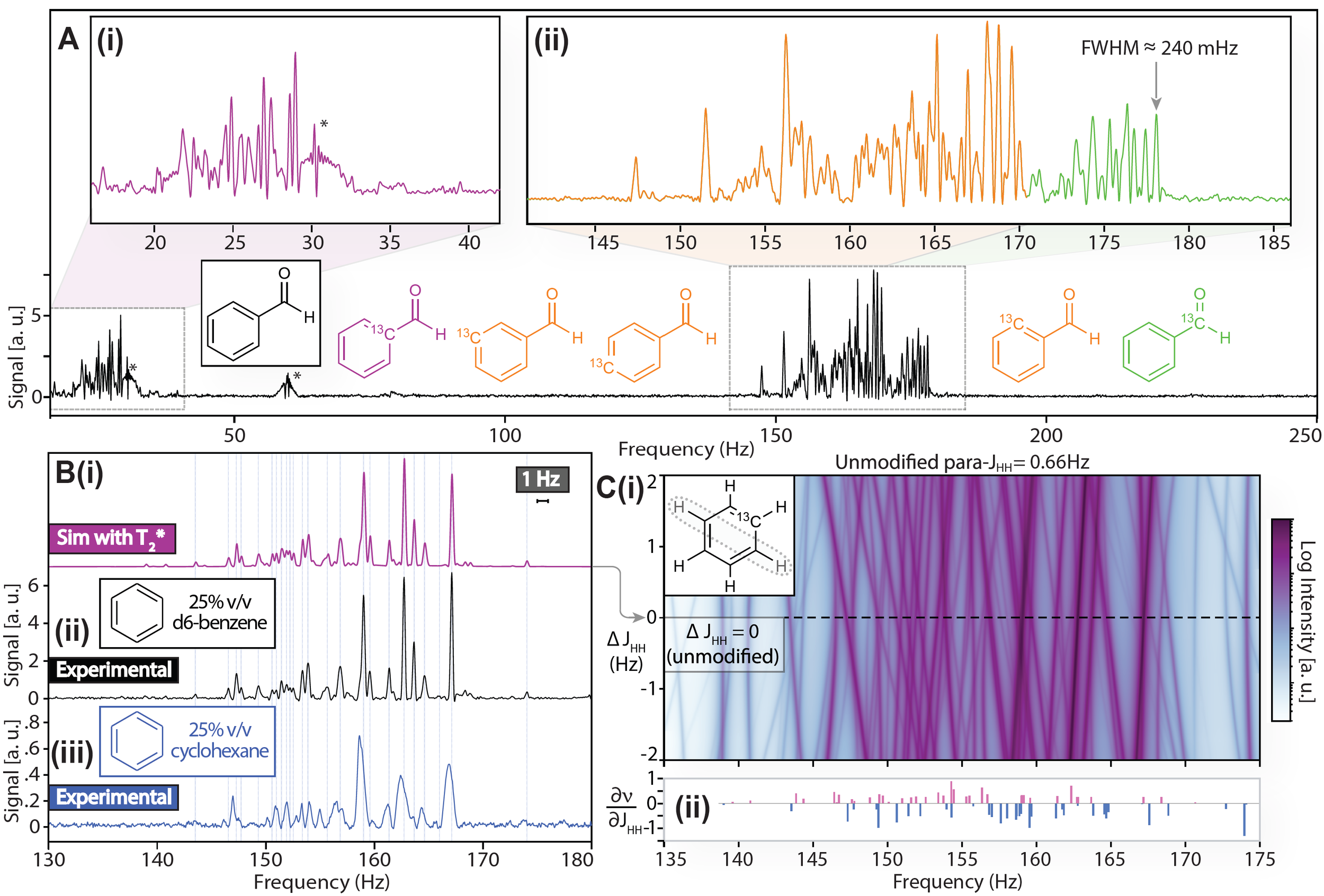
Zero-field (ZF) nuclear magnetic resonance (NMR) spectroscopy probes scalar J-couplings between nuclei while dispensing with large homogeneous magnetic fields, enabling low-cost and geometrically flexible detection, including through conductive enclosures. Despite these advantages, its broader use for chemical analysis has been limited by sensitivity and by the difficulty of predicting the dense spectral multiplets that arise at zero field. Here we demonstrate natural-abundance (1.1%) 13C ZF spectroscopy on off-the-shelf liquids using a compact commercial 87Rb magnetometer for the first time, without hyperpolarization or special sample preparation. Instrumental advances yield improved sensitivity, ≤250-mHz linewidths and >week-long stability, enabling isotopomer-resolved fingerprint spectra across a 13-molecule library, including the ability to discern rare (0.0121%) doubly 13C-labelled species. In parallel, we demonstrate vibrationally corrected density-functional theory (DFT) based prediction of ZF NMR spectra for chemically diverse molecules with few-hertz accuracy. Comparing experiment with these calculations renders residual deviations as chemically informative, reporting on hydrogen bonding, hydration and ion pairing at high ionic strength. Together, these results contribute towards DFT-assisted ZF NMR as a general platform for field-constraint-free molecular identification and for extracting transient solution-state structure from responsive J-coupling observables.
