
71. Out-of-time-order correlators bridge classical transport and quantum dynamics
Sophia N. Fricke, Haiyan Mao, Manas Sajjan, Ashok Ajoy, Velencia Witherspoon, Sabre Kais, Jeffrey A. Reimer [PDF]
arXiv:2508.20235 — J. Chem. Phys. 164, 134201 (2026)
Abstract:
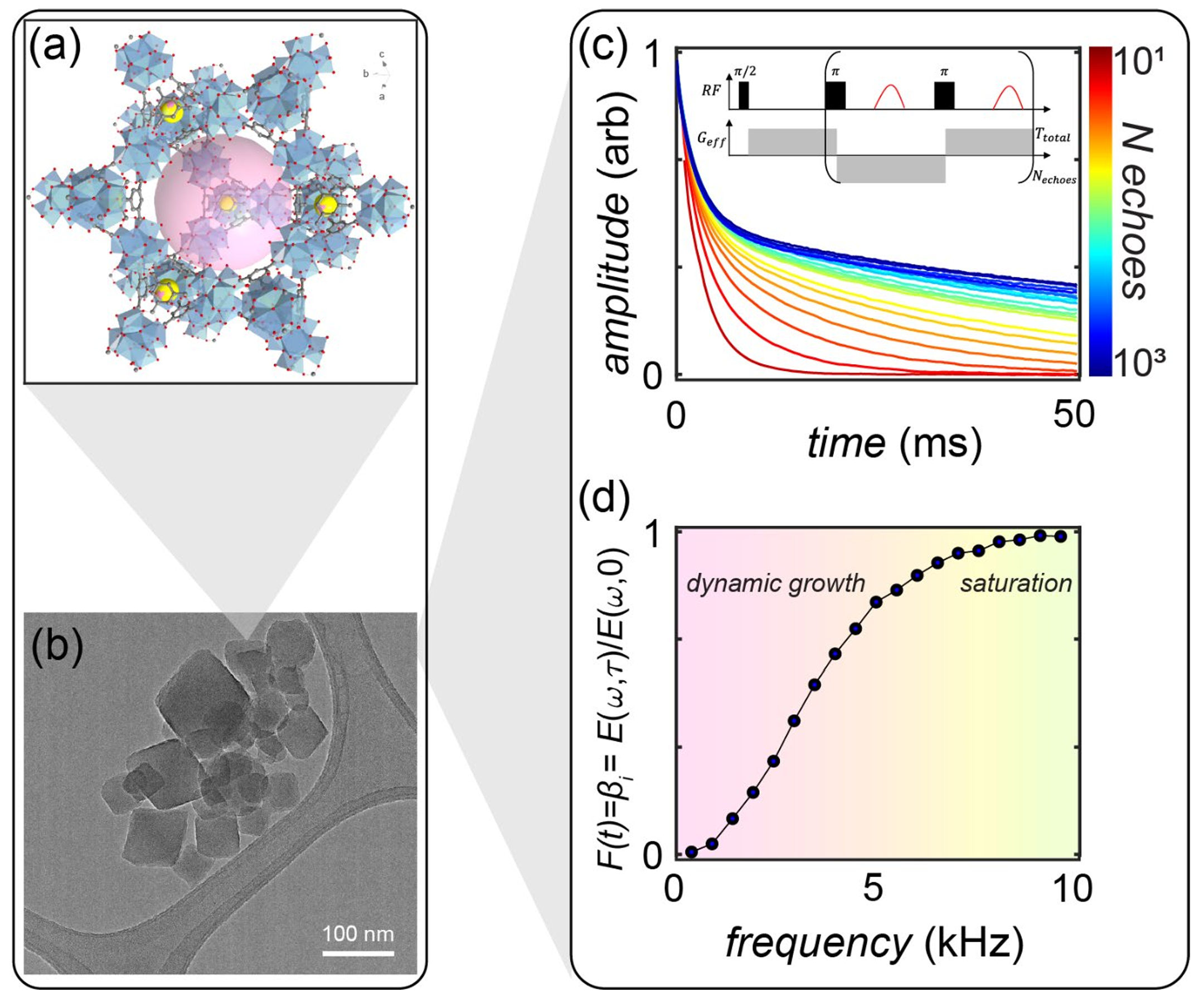
The out-of-time-order correlator (OTOC) has emerged as a central tool for quantifying decoherence across wide-ranging physical platforms. Here we demonstrate its direct measurement in a classical ensemble using nuclear magnetic resonance (NMR) with a modulated gradient spin echo (MGSE) sequence and extend the method into a multidimensional correlation to track exchange phenomena. Position is encoded through magnetic field gradients and momentum through the velocity autocorrelation function, enabling experimental access to OTOCs for proton motion confined within the self-similar lattice of the metal-organic framework MOF-808. Here, water confined to specified geometries within the MOF pores gives rise to spatially distinct diffusive eigenmodes with characteristic relative entropies. We demonstrate that periodic radiofrequency (rf) driving combined with gradient modulation yields entropy evolution through the selection of distinct diffusion modes. Frequency-resolved diffusion spectra connect these entropy dynamics to classical heat-exchange laws, revealing how operational features of quantum systems are mirrored in confined, macroscopic spin ensembles.
